emem protocol (v1.2.1)
The wire spec below is the concrete encoding; the formal object, the property table, and the memory algebra live in the memory model.
What this document promises
Bytes on the wire. Anyone implementing emem in another language reads this
document, follows it line by line, and produces byte-identical receipts to
a Rust responder running the same registry CIDs. Where the prose diverges
from crates/emem-codec, crates/emem-fact, crates/emem-attest, or
crates/emem-storage, the source is canonical and this document is the
bug. Every encoding rule cites the file and line that defines it.
1. Cell64: the spatial primitive
A Cell64 is a 64-bit integer that addresses a quantised lat/lng bucket on
the WGS-84 ellipsoid. The wire form is four base-65,536 digits joined by
dots, e.g. dedi.zaf00.bafi.baba. The integer form is what gets hashed
and compared; the dotted text form is what shows up inside facts and
receipts.
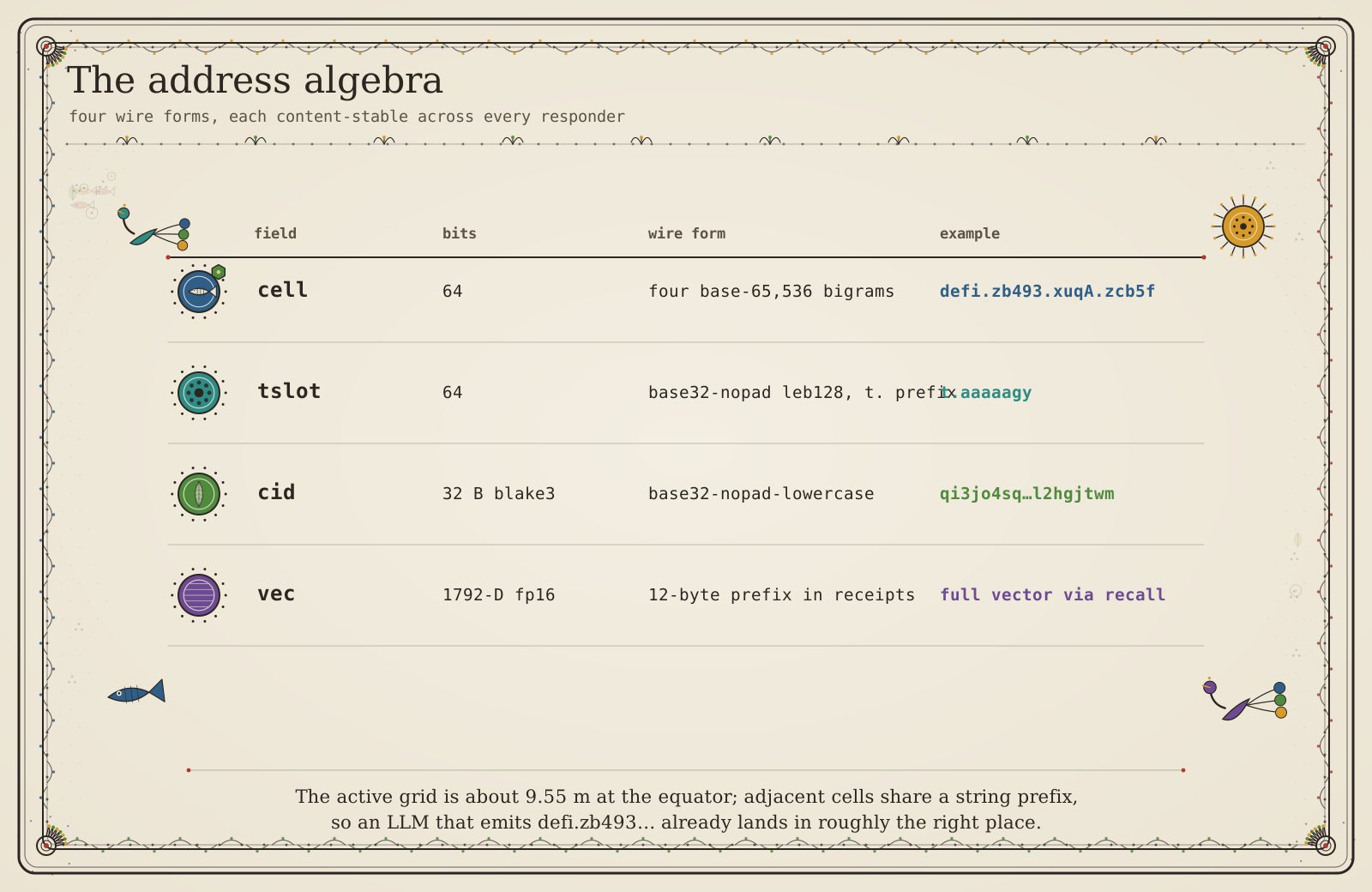 The full address pipeline at a glance. Section 4 walks each box; the SVG also names every constant the encoder uses.
1.1 Bit layout
Defined in crates/emem-codec/src/geo.rs:38-45.
 bit  63           60 59         52 51         44 43 42         22 21          0
      +-------------+--------------+-------------+--+-------------+--------------+
      |  mode (4)   | resolution(8)|   base (8)  |R |  lat_q (21) |  lng_q (22)  |
      |   0b0001    |     21       |     0xab    |0 |             |              |
      +-------------+--------------+-------------+--+-------------+--------------+
| Bits | Field | Value | Purpose |
|---|---|---|---|
| 63..60 | mode | 0b0001 | distinguishes cell from edge/vertex/set |
| 59..52 | resolution | 21 | encoded as the lat-axis bit count |
| 51..44 | base | 0xab | “geo aperture” marker, separates this layout from H3-style cells |
| 43..43 | reserved | 0 | must be zero on encode; pass-through on decode |
| 42..22 | lat_q | 21 bits | quantised latitude, [0, 2^21) over the 180° range |
| 21..00 | lng_q | 22 bits | quantised longitude, [0, 2^22) over the 360° range |
The lat axis carries one fewer bit than the lng axis on purpose: 180° / 2^21 ≈ 360° / 2^22, so the bucket is square at the equator (~9.54 m × ~9.55 m). Equal bit counts would give 1:2-rectangular cells.
1.2 Encoding rule (lat/lng → Cell)
Defined in crates/emem-codec/src/geo.rs:75-82:
#![allow(unused)]
fn main() {
pub fn cell_from_latlng(lat_deg: f64, lng_deg: f64) -> Cell {
    let lat = lat_deg.clamp(-90.0, 90.0);
    let lng = ((lng_deg + 180.0).rem_euclid(360.0)) - 180.0;
    let lat_q = (((lat + 90.0) / 180.0) * GEO_LAT_MAX as f64).round() as u64 & GEO_LAT_MASK;
    let lng_q = (((lng + 180.0) / 360.0) * GEO_LNG_MAX as f64).round() as u64 & GEO_LNG_MASK;
    let path = (lat_q << GEO_LNG_BITS) | lng_q;
    Cell::from_raw(GEO_PREFIX | path)
}
}
Constants (geo.rs:50-71):
GEO_LAT_BITS=21, GEO_LNG_BITS=22,
GEO_LAT_MAX=(1<<21)-1=2_097_151,
GEO_LNG_MAX=(1<<22)-1=4_194_303,
GEO_RES=21 (resolution tag),
GEO_BASE=0xab (aperture marker),
GEO_PREFIX = (1 << 60) | (21 << 52) | (0xab << 44) = 0x1150_ab00_0000_0000.
Lat clamps to [-90, 90]. Lng wraps via rem_euclid (-181° →
+179°). Quantisation is f64::round
(round-half-away-from-zero).
1.3 Text form: 4 bigrams + dots
Defined in crates/emem-codec/src/cell64.rs:14-24. The 64-bit integer
is split into four 16-bit lanes (d0=raw>>48, d1=raw>>32,
d2=raw>>16, d3=raw, each masked to 16 bits) and each lane indexes
a 65,536-entry alphabet built deterministically in
crates/emem-codec/src/alphabet.rs:22-46:
- Consonants:
b c d f g h j k l m n p q r s t v w x y z(21). - Vowels:
a e i o u A E I O U(10). - Bigrams: outer product
c1·v1·c2·v2, in that exact loop order → 21 × 10 × 21 × 10 = 44,100 bigrams covering indices 0..44,099. - Indices 44,100..65,535 are filled with synthetic codepoints
z<hex4>, where<hex4>is the four-digit lowercase hex of the index itself.
Index → bigram is O(1) via ALPHABET[i]; bigram → index is O(1)
via the precomputed reverse map ALPHABET_INDEX.
1.4 Worked example: lat=0.0, lng=0.0
Apply cell_from_latlng:
lat_q = round(0.5 × 2_097_151) = 1_048_576(round-half-away-from-zero).lng_q = round(0.5 × 4_194_303) = 2_097_152.path = (1_048_576 << 22) | 2_097_152 = 0x0000_0400_0020_0000.raw = GEO_PREFIX | path = 0x1150_ab00_0000_0000 | 0x0000_0400_0020_0000 = 0x1150_af00_0020_0000.
The four 16-bit lanes are
d0=0x1150 (4432),
d1=0xaf00 (44800),
d2=0x0020 (32),
d3=0x0000 (0).
Index i in the structured-bigram region (0..44,099) decomposes as
i = c1·2100 + v1·210 + c2·10 + v2 from alphabet.rs. Indices ≥
44,100 fall into the synthetic z<hex4> region.
d0 = 4432 = 2·2100 + 1·210 + 2·10 + 2→d e d i→dedi.d1 = 44800≥ 44,100 →"z" + "af00"→zaf00.d2 = 32 = 0 + 0 + 3·10 + 2→b a f i→bafi.d3 = 0→b a b a→baba.
Cell64 for (lat=0.0, lng=0.0) is
dedi.zaf00.bafi.baba
1.5 Decode rule (cell64 → lat/lng)
latlng_from_cell64 (geo.rs:96-117) inverts the encode: parse the
four bigrams via from_cell64 (cell64.rs:41-54), reject if
(raw & 0xFFFF_F000_0000_0000) != GEO_PREFIX (guards against legacy;
see §1.7), then unpack
lng_q = raw & GEO_LNG_MASK, lat_q = (raw >> 22) & GEO_LAT_MASK,
and convert with lat_deg = (lat_q/GEO_LAT_MAX)·180 - 90 and
lng_deg = (lng_q/GEO_LNG_MAX)·360 - 180. The bucket bbox extends
±half_lat / ±half_lng from the centre, clipped to [-90, 90] on lat.
1.6 Round-trip and edge cases
The tests in geo.rs:139-241 pin the contract.
- Sub-quantum collision (geo.rs:198-202): two queries 9 µ° apart (~1 m) MUST produce the same cell: the cell’s grain, not a bug.
- 12 m apart distinguishes (geo.rs:187-193): two queries
1.08e-4°apart (~12 m) MUST produce different cells. - Antimeridian (geo.rs:178-180):
lng = 179.99round-trips;lng = -181wraps to+179. - Polar clamp (geo.rs:76):
lat = 95clamps to90. - Square at equator (geo.rs:207-225): bucket extent is 8 to 12 m on both axes; lat and lng agree to within 5%.
1.7 Legacy 16-bit grid: rejected
Pre-0.0.3 emem used a GEO_RES = 12 (16-bit-per-axis, ~305 m) grid.
That encoding is not decodable by the current codec. The test at
geo.rs:231-241 constructs a legacy-shaped raw word and confirms
latlng_from_cell64 returns Err(CodecError::NotGeoCell): the
resolution field changed (12 → 21), GEO_PREFIX_MASK keys on it, so
legacy strings fail closed instead of silently misplacing a fact by
hundreds of metres. Implementations MUST NOT serve, accept, or quietly
upgrade legacy cell64 strings.
2. Tslot: temporal addressing
A Tslot is a u64 bucket index of the Unix timeline at a band’s
declared tempo cadence. Defined in crates/emem-core/src/tslot.rs:19-22.
2.1 Anchor: Unix epoch, not emem epoch
Pre-0.0.3 emem anchored tslot at 2026-01-01T00:00:00Z (EMEM_EPOCH_UNIX = 1_767_225_600). That broke history: every pre-2026 observation
collapsed to Tslot(0). The current code (tslot.rs:56-68) computes
Tslot(unix_seconds.max(0) / tempo.slot_seconds())
The constant EMEM_EPOCH_UNIX is retained as protocol metadata only;
nothing in the encode path subtracts it. Pre-1970 (negative Unix)
inputs clamp to Tslot(0).
2.2 Tempo class
Defined in tslot.rs:24-37, 43-54. Five variants:
| Variant | slot_seconds() | Cadence | Sample bands |
|---|---|---|---|
Static | 0 | never changes | DEM, Köppen, lcv-1 |
Slow | 31_536_000 | 365 d | Tessera (2017..2024 vintages + multi_year 1024-D + bin128), soil |
Medium | 2_592_000 | 30 d | NDVI composites |
Fast | 86_400 | 1 d | raw S2 NDVI |
UltraFast | 3_600 | 1 h | weather, traffic |
Static returns Tslot(0) regardless of input; the slot is
meaningless for a band that never refreshes. to_unix_start is the
inverse: the Unix second at which the slot opened.
2.3 Cadence overlap
seconds since 1970   ─────────────────────────────────────────────►
                     0                                            now

Static     [   one bucket forever                               ]
Slow       [365d][365d][365d][365d][365d][365d][365d][365d][365d]
Medium     |30d|30d|30d|30d|30d|30d|30d|30d|30d|30d|30d|30d|30d|
Fast       ||||||||||||||||||||||||||||||||||||||||||||||||||||||
UltraFast  ::::::::::::::::::::::::::::::::::::::::::::::::::::::

Sample-band cadences:
- Tessera annual:  one Slow slot per year         (Slow)
- MODIS NDVI:      one Fast slot per 8-day comp   (Fast)
- Open-Meteo:      one UltraFast slot per hour    (UltraFast)
2.4 Text form: t.<base32-nopad-leb128>
Defined in crates/emem-codec/src/tslot_text.rs:9-13. The integer is
encoded as little-endian LEB128 (varint), then the byte string is
base32-encoded with data_encoding::BASE32_NOPAD and lowercased.
#![allow(unused)]
fn main() {
fn to_tslot_text(t: Tslot) -> String {
    let mut buf = [0u8; 10];
    let n = encode_varint(t.0, &mut buf);
    format!("t.{}", BASE32_NOPAD.encode(&buf[..n]).to_lowercase())
}
}
Worked examples (matching the test at tslot_text.rs:70-77):
Tslot(0)→ varint[0x00]→ base32"AA"→ textt.aa.Tslot(1)→ varint[0x01]→ base32"AE"→ textt.ae.Tslot(26)→ varint[0x1A]→ base32"DI"→ textt.di.Tslot(1024)→ varint[0x80, 0x08]→ base32"QAEA"→ textt.qaea.
Decode inverts the chain (tslot_text.rs:16-23): strip t., uppercase
the body, base32-decode, LEB128-decode.
3. CID and FactCid
emem uses BLAKE3 over canonical CBOR. The hash bytes are encoded with
data_encoding::BASE32_NOPAD and lowercased. There are exactly two
durable lengths:
| Form | Bytes | Chars | Source | Use |
|---|---|---|---|---|
cid64 | 8 | 13 | crates/emem-codec/src/cid64.rs:9-11 | short visible ID for inline text |
FactCid | 16 | 26 | crates/emem-fact/src/cbor.rs:38-41 (base32_prefix(&hash, 16)) | durable storage and signing |
The full 32-byte hash is computed once (blake3_32, cbor.rs:30-35);
the two encodings are prefixes.
3.1 cid64
#![allow(unused)]
fn main() {
pub fn to_cid64(cid: &[u8; 32]) -> String {
    BASE32_NOPAD.encode(&cid[..8]).to_lowercase()
}
}
8 bytes = 64 bits → ceil(64/5) = 13 base32 characters. Decode-only
inversion (from_cid64, cid64.rs:15-25) returns the [u8; 8]
prefix; full collision resistance requires the full 32-byte CID.
3.2 FactCid
FactCid is a string newtype (cid.rs:25). The construction is
FactCid = base32_nopad_lowercase( blake3( canonical_cbor(fact) ) )
The full 32-byte digest, which is 52 base32 characters. It is not
truncated, and the difference is not cosmetic: a reader who truncates
computes an identifier that can never match a real fact_cid, so every
lookup misses and every signature check fails, in a way that looks like a
corrupt corpus rather than a wrong rule.
This page said [..16] until 2026-08-13, and so did the agent guide. The
whitepaper’s own errata already called that the most consequential error
in the v1 draft, and it was still live in two other documents, which is
the failure this repo keeps finding: a correction lands where it was
noticed and not where it is read. dpwotikn reported the widths as
inconsistent across our documents while building a telescope pipeline,
and they were right.
The truncated rule is real but belongs to two other identifiers:
entity_cid and bundle_cid are blake3(...)[..16], 26 characters,
because they anchor a reference rather than binding a whole body.
Mutating any field of the fact changes its CBOR bytes and therefore its
FactCid; the round-trip test at crates/emem-fact/tests/round_trip.rs
(CBOR → decode → re-encode → byte-equal) pins this.
The same recipe constructs the other newtypes from cid.rs:25-34:
RegistryCid, SchemaCid, ReasonCid, BatchCid, CoverageCid.
3.3 Manifest CID
For the eight registries (bands, algorithms, functions, sources, topics, schema, lcv-1, alphabet) the recipe is identical:
manifest_cid = base32_nopad_lowercase( blake3( canonical_cbor(manifest) )[..32] )
Full 32 bytes (52 chars). The bigger size is acceptable here because a
manifest CID appears once per response in registry_cid / schema_cid,
not once per fact.
4. CBOR canonicalisation
Defined in crates/emem-fact/src/cbor.rs.
#![allow(unused)]
fn main() {
pub fn to_canonical_cbor<T: serde::Serialize>(v: &T) -> Result<Vec<u8>, ...> {
    let mut buf = Vec::new();
    ciborium::ser::into_writer(v, &mut buf)?;
    Ok(buf)
}
}
The encoder is ciborium::ser::into_writer. ciborium emits RFC 8949
deterministic encoding when the input traversal is deterministic.
For serde-derived structs that holds: fields serialise in declaration
order. For freeform maps (ciborium::Value::Map) callers MUST present
the map with already-sorted keys; emem does not re-sort silently.
4.1 emem CBOR tags
crates/emem-fact/src/cbor.rs:6-13.
| Tag | Meaning | Tagged value |
|---|---|---|
| 65000 | emem cell | u64 packed per §1.1 |
| 65001 | emem tslot | u64 |
| 65002 | emem vec64 | 32-byte vector CID |
| 42 | IPLD CID | base32 multibase string (b...) |
Two implementations MUST produce byte-identical CBOR for the same fact.
A round-trip test (encode → decode → encode → byte-compare) is the
gate; crates/emem-fact/tests/round_trip.rs enforces it.
4.2 What “canonical” means here, concretely
- Length encodings minimal (CBOR head byte is the shortest form
ciboriumemits). - Field order = serde declaration order. For
PrimaryFactthat iscell, band, tslot, value, unit?, confidence, uncertainty?, sources, derivation, privacy_class, schema_cid, signer, signed_at(fact.rs:38-67). Option::Nonefields with#[serde(skip_serializing_if = "Option::is_none")]are absent from the CBOR map (not encoded as null).- Floats serialise as f64 unless declared
f32.confidence: f32emits CBOR major type 7 with f32 head.
5. Fact
Three variants. All carry signer: AttesterKey (32-byte ed25519
public key) and signed_at: String (ISO 8601 UTC), so any fact can be
attributed without referring to its enclosing attestation.
5.1 PrimaryFact
crates/emem-fact/src/fact.rs:37-67.
#![allow(unused)]
fn main() {
struct PrimaryFact {
    cell: String,                       // cell64 string
    band: String,                       // e.g. "indices.ndvi"
    tslot: u64,                         // bucket per band tempo
    value: ciborium::Value,             // band-typed (number, vector, enum)
    unit: Option<String>,               // SI unit when applicable
    confidence: f32,                    // 0..1
    uncertainty: Option<Uncertainty>,
    sources: Vec<Source>,               // ≥1
    derivation: Derivation,             // recipe for re-execution
    privacy_class: String,              // serialised at attest time
    schema_cid: SchemaCid,
    signer: AttesterKey,                // [u8; 32]
    signed_at: String,                  // ISO 8601 UTC
}
}
Worked example (Fast-tempo NDVI composite over a single Sentinel-2 capture):
{
  "kind": "primary",
  "cell": "dedi.zaf00.bafi.baba",
  "band": "indices.ndvi",
  "tslot": 19797,
  "value": 0.42, "unit": null, "confidence": 0.95,
  "sources": [{ "scheme": "sentinel_s2_l2a",
                "id": "https://…/T43PFT_20240315T101031_B08_10m.tif ; https://…/T43PFT_20240315T101031_B04_10m.tif",
                "captured_at": "2024-03-15T10:10:31Z" }],
  "derivation": { "fn_key": "sentinel2_l2a_indices_ndvi@1", "args": [/* lat, lng, scene, cloud, days, …, catalogue, dn_offset */] },
  "privacy_class": "public",
  "schema_cid": "bn7c...",
  "signer": [/* 32 bytes */],
  "signed_at": "2024-03-15T11:02:14Z"
}
tslot=19797 at Fast tempo (86_400 s) inverts to Unix
19797 × 86_400 = 1_710_460_800 = 2024-03-15T00:00:00Z, the start of the
capture’s day.
5.2 DerivativeFact
fact.rs:71-94.
#![allow(unused)]
fn main() {
struct DerivativeFact {
    cell: String, band: String,
    tslot_window: [u64; 2],             // inclusive [start, end]
    op: String,                         // delta | mean | trend | rate | anomaly
    parents: Vec<FactCid>,              // input fact CIDs
    value: ciborium::Value,
    confidence: f32,
    derivation: Derivation,
    schema_cid: SchemaCid,
    signer: AttesterKey,
    signed_at: String,
}
}
Worked example (90-day NDVI mean over three monthly composites):
{
  "kind": "derivative",
  "cell": "dedi.zaf00.bafi.baba",
  "band": "indices.ndvi",
  "tslot_window": [665, 667],
  "op": "mean",
  "parents": ["fc6...26char", "ab2...26char", "9k4...26char"],
  "value": 0.39, "confidence": 0.92,
  "derivation": { "fn_key": "agg.mean@1" },
  "schema_cid": "bn7c...",
  "signer": [/* 32 bytes */],
  "signed_at": "2024-04-01T03:11:00Z"
}
A derivative’s signed_at is part of its CID, so a responder derivative
that should be comparable across calls takes it from its inputs rather
than the wall clock. The change ledger (change_attribution@1) signs the
newest parent’s signed_at (the epoch when it read nothing), so equal
inputs give one fact and one token, and a repeat call returns the stored
fact (persistence: "existing_derivative_fact"). When the responder signed
it is still in the attestation and the receipt.
Caller-registered derivations (POST /v1/derive)
A responder computes derivatives of its own. A caller can also register
one: a value it computed itself over facts the responder holds. The
result is an ordinary DerivativeFact with an ordinary
emem:fact:<cell64>:<fact_cid> token, which is the point. A world model
built out of emem facts can hand a stranger one string that resolves,
verifies, and names its parents, instead of asserting a conclusion and
asking to be believed. A verifier walks parents down to the
responder’s own signed measurements.
Three rules make that safe to expose.
1. Every parent must resolve here. Each inputs[] entry is parsed,
fetched, and checked against the cell it claims. A token naming a fact
this responder does not hold is refused with 404 derive_parent_unresolved naming the index that failed; a real
fact_cid under a false cell is refused with 409 derive_parent_cell_mismatch. Unvalidated parents would be fake lineage,
which is worse than none: it would let a token’s ancestry look like it
terminates in signed measurements when it terminates in nothing.
2. The provenance class must be a caller class. model_output,
human_curated, or estimator, declared by the caller and validated by
the responder. estimator is for a quantity FITTED from data that a
third party holding your signed inputs, your named estimator and your
seed would reproduce exactly; it is admissible here for the same reason
model_output is, because the responder records what you declared rather
than vouching for it, and it tells a reader something model_output
cannot: that reproduction is possible at all.
direct_sensor and deterministic_index are refused with 400 derive_provenance_class_refused. Those two classes assert
tamper-evidence (a sensor produced this, or anyone can recompute it
from the cited raw source) and the responder can assert neither about
arithmetic it never saw.
3. It must be attested, and the signature means something narrow.
What the responder’s signature attests: that this attester submitted this derivation, over these parent facts, at this time, and that the responder stored it. It does not attest that the value is true. The responder did not compute it and cannot recompute it.
signer on the fact is the responder’s key, because the responder’s
own identity is the only one it can sign with, and minting a fact that
claimed the caller’s key had signed the fact’s canonical CBOR would be a
forgery: the caller signed the derive preimage, not the fact body. The
caller’s binding is recorded inside derivation.args, hence inside the
fact_cid, hence covered by the responder’s signature:
"derivation": {
  "fn_key": "same_doy_ndvi_delta@1",     // the CALLER's recipe; never executed here
  "args": {
    "attester_pubkey_b32": "...",        // whose claim this is
    "attester_sig_b32": "...",           // the caller's own ed25519 signature
    "body_hash_hex": "...",              // what that signature covers
    "inputs": ["emem:fact:...", "..."],  // the parent tokens as submitted
    "provenance_class": "model_output",
    "code_cid": null,
    "preimage": "blake3(\"emem.memory_write|derive|/v1/derive|\" || body_hash)",
    "submitted_via": "emem.derive.v1"
  }
}
Every field of the signed body is recoverable from the stored fact, so a
third party holding only the fact can rebuild body_hash, rebuild the
preimage, and re-check the caller’s signature without the original
HTTP request. That is the difference between recording “some key signed
something” and proving “this key signed this derivation”.
The preimage
The binding reuses the memory-write attester scheme unchanged (§ see
crates/emem-primitives/src/memory_acl.rs), with verb = "derive" and
path = "/v1/derive":
sig       = ed25519(blake3("emem.memory_write|derive|/v1/derive|" || body_hash))
body_hash = blake3(cbor(DeriveBody))
One scheme, one verifier. The verb is what separates the domains: no
memory-file verb is spelled derive, so a signature minted for a file
write cannot be replayed as a derivation or the reverse. The literal
emem.memory_write prefix is the domain for every caller-attested write
at this responder, not only file writes; it is spelled that way because
renaming it would invalidate every memory-write signature already
issued.
cbor(DeriveBody) is a definite-length 10-entry map whose keys appear
in declaration order:
| # | key | encoding |
|---|---|---|
| 1 | fn_key | text |
| 2 | inputs | array of text, in caller order (order is signed) |
| 3 | cell | text |
| 4 | band | text |
| 5 | tslot_window | array of two unsigned ints |
| 6 | op | text |
| 7 | value | RFC 8949 §4.2 deterministic; floats canonicalised first |
| 8 | confidence | CBOR float32 (0xfa + IEEE-754 binary32) |
| 9 | provenance_class | text |
| 10 | code_cid | text, or CBOR null when omitted |
Two traps worth stating plainly, because a generic encoder gets both wrong:
- The outer map is not RFC 8949 §4.2.1 key-sorted. It is declaration order. A canonical-CBOR library pointed at this map will sort the keys and compute the wrong digest.
confidenceis a float32, not a float64, becauseDerivativeFact::confidenceis anf32and the signed body has to match the stored fact bit-for-bit or the reconstruction above breaks.
Nested maps inside value are sorted by their encoded key bytes, per
§4.2.1, so the digest does not depend on the caller’s JSON key order.
You do not have to implement any of this. Send the request with no
attester block. The 401 derive_attestation_required response carries
details.how_to_sign.sign_this.digest_hex: the exact 32 bytes the
responder will verify against, plus the full byte-level rules and a
worked example. Sign that digest, re-send the byte-identical body with
the signature attached. The digest is a pure function of the request, so
nothing about it is secret and nothing about it expires. The rules above
are published for verifiers rebuilding a digest from a stored fact, and
for clients that would rather sign in one round-trip.
Tenancy: derived facts are attester-scoped
A caller-registered derivative is untrusted input, so it must never reach another agent’s default read. It does not, and not because of a filter:
fact_canonical_keyreturnsNonefor theDerivativevariant (crates/emem-cache/src/sled_hot.rs), so a derivative is stored content-addressed but is never written to the canonical index, the multi-attester index, or the scope index.
Every keyed read walks one of those indexes. So recall,
recall_polygon, state, query_region, memory_search and
find_similar cannot return a caller’s derivation at all. The absence
is structural rather than six filters someone has to remember to apply.
This is the point rather than a limitation: registering a derivation
buys citation and resolution, not an assertion into the commons.
Two reads reach a derivation, and both require naming it:
- Its token.
POST /v1/memory_token/resolve(orGET /v1/facts/<fact_cid>). A derivation is not a new token family, it is a fact. POST /v1/derived, which requiresattester_pubkey_b32. There is no all-attesters form. A required pubkey is a stronger guarantee than an optional filter onrecall, where a futureattester: Nonecould silently come to mean “everyone”.
POST /v1/derive is idempotent per (attester, body_hash). A
repeat submission returns the token already minted for it, flagged
deduplicated: true, so retrying a timed-out call is safe. This is an
explicit index rather than a consequence of content-addressing: because
signed_at rides on the fact, two identical submissions inside one
second would collapse to a single CID while two a second apart would
not, and “idempotent if you retry fast enough” is not a contract a
caller can code against. Dedup is scoped to the attester: two keys
making the same claim are two claims, and each gets its own token.
5.3 NegativeFact
fact.rs:98-117.
#![allow(unused)]
fn main() {
struct NegativeFact {
    cell: String, band: String, tslot: u64,
    reason_cid: ReasonCid,              // evidence (e.g. an S1 scene CID)
    confidence: f32,
    sources: Vec<Source>,               // ≥1
    schema_cid: SchemaCid,
    signer: AttesterKey,
    signed_at: String,
}
}
A negative fact is not the same as a missing record. Missing means
“no responder has attested this (cell, band, tslot)”. Negative means
“I looked and there was nothing; here is what I looked at
(reason_cid)”. Per the no-silent-fallbacks rule, the API must
distinguish these states; see §10.
Signed Absence as a first-class protocol move
Every band that has no data at a cell returns a NegativeFact,
referred to throughout the codebase as a signed Absence. The
Absence itself is content-addressed (it has a FactCid), signed by
the responder, and citable on the same footing as a Primary or
Derivative fact. The reason_cid carries a typed enumeration:
| Reason | When the responder emits it |
|---|---|
outside_coverage | The query falls outside the dataset’s spatial or temporal window (DMSP-OLS post-2013, CHIRPS poleward of ±50°, Köppen pixel value 0 over open ocean). |
unavailable_capability | A required upstream is reachable but does not expose the requested layer (Hansen 80°N tile genuinely not published; Overture release lacks the queried theme). |
gpu_unavailable | Registered for a GPU-tier band; not produced by this responder, which runs no GPU tier. |
archetype_seed_unavailable | A climate-archetype query landed in a Köppen-Geiger zone that the v1 centroid seed file does not yet cover. |
upstream_no_data | Upstream returned an empty result with no error (WorldPop total_population == 0; FIRMS bulk CSV with no fire detection inside the window). |
A signed Absence is a working answer, not an error path. A verifier holding the Absence’s receipt can replay the same upstream call and expect the same empty result; downstream agents can pin reasoning on “the responder looked and confirmed nothing was there” instead of guessing why a recall came back empty.
5.4 Tagged enum on the wire
fact.rs:9-25. The Fact enum serialises with #[serde(tag = "kind", rename_all = "snake_case")]. CBOR shape: a single map with "kind"
keying the string discriminator "primary" | "derivative" | "absence"
plus the variant’s fields flattened in.
6. Attestation envelope
crates/emem-fact/src/attest.rs:10-28.
#![allow(unused)]
fn main() {
struct Attestation {
    facts: Vec<Fact>,
    batch_root: [u8; 32],               // blake3 merkle root of CBOR(fact_i)
    attester: AttesterKey,
    attester_key_epoch: KeyEpoch,
    registry_cid: RegistryCid,
    schema_cid: SchemaCid,
    signature: Signature,               // [u8; 64]
    attested_at: String,                // ISO 8601 UTC
}
}
The signature is over
ed25519_sign( blake3( batch_root || registry_cid_bytes || schema_cid_bytes ) )
where registry_cid_bytes and schema_cid_bytes are the string
bytes (UTF-8 of the lowercase base32 CID), not the raw hash bytes.
That is what verify_attestation (crates/emem-storage/src/lib.rs:428-438)
passes to BLAKE3:
#![allow(unused)]
fn main() {
let mut h = Hasher::new();
h.update(&att.batch_root);
h.update(att.registry_cid.as_str().as_bytes());
h.update(att.schema_cid.as_str().as_bytes());
let msg = h.finalize();
let pk = ed25519_dalek::VerifyingKey::from_bytes(&att.attester.0)?;
let sig = ed25519_dalek::Signature::from_bytes(&att.signature.0);
pk.verify_strict(msg.as_bytes(), &sig)?;
}
6.1 Merkle root construction
crates/emem-attest/src/lib.rs:11-89. Leaves are the
blake3(canonical_cbor(fact)) hashes, sorted bytewise. The empty input
returns [0u8; 32].
Every leaf is promoted by self-hash before pairing: the leaf
becomes blake3(leaf || leaf). The self-hash separates the “leaf” and
“internal node” domains; without it, an attacker who knows a
CBOR(fact) could splice it in at an internal position. The test
single_leaf_is_self_hashed (lib.rs:128-139) pins the rule for the
1-leaf case: merkle_root([leaf]) == blake3(leaf || leaf).
Once promoted, layers fold pairwise with blake3(left || right). For
odd-cardinality layers the trailing element pairs with itself
(lib.rs:36-44, lib.rs:174-194).
ASCII tree for 4 facts with sorted CBOR-hashes C0 ≤ C1 ≤ C2 ≤ C3:
                          root
                       blake3(L01 || L23)
                      /                 \
              L01 = blake3(l0 || l1)  L23 = blake3(l2 || l3)
              /          \             /          \
       l0 = b3(C0||C0)  l1=b3(C1||C1)  l2=b3(C2||C2)  l3=b3(C3||C3)
            |               |               |              |
       CBOR(fact0)     CBOR(fact1)     CBOR(fact2)     CBOR(fact3)
6.2 Verify-on-write
crates/emem-storage/src/lib.rs:407-440 (verify_attestation). Every
attestation re-checks the merkle root and the ed25519 signature
before it is persisted; no bypass:
- CBOR-encode each fact, take
blake3(bytes)→ leaf. - Sort leaves bytewise.
emem_attest::merkle_root(&leaves)must equalatt.batch_root, elseStorageError::AttestationInvalid("merkle root mismatch …").- Recover
VerifyingKey::from_bytes(&att.attester.0). vk.verify_strict(blake3(batch_root || registry_cid || schema_cid), sig)must succeed, elseAttestationInvalid("bad signature …").
Failure → write rejected. The HTTP layer surfaces this as the
BadSignature error code from crates/emem-core/src/error.rs.
7. Receipt
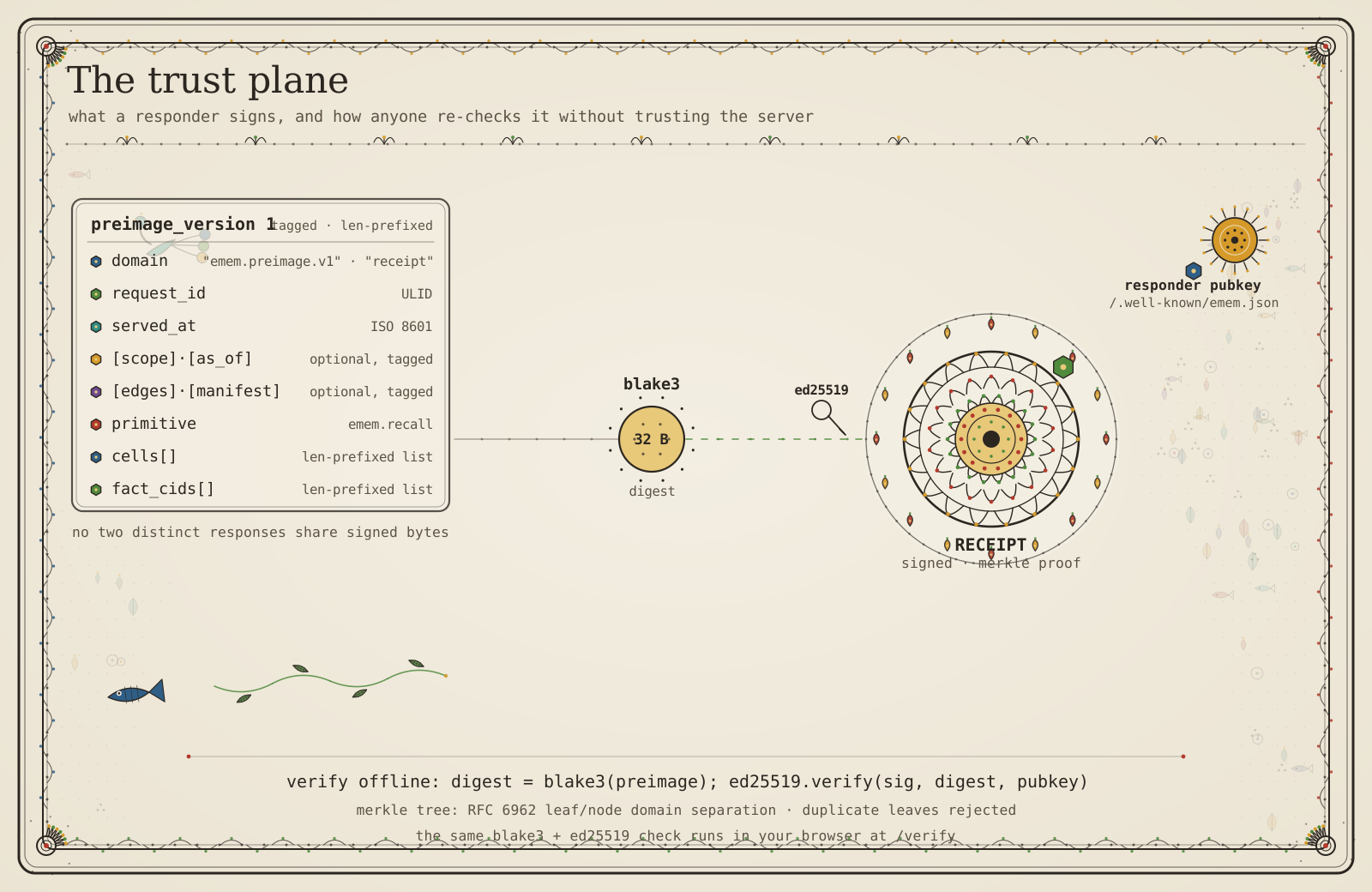 The five-step trust pipeline. Section 7.2 specifies the preimage byte-by-byte; sections 8 and 9 cover the Merkle path and the append-only log.
crates/emem-fact/src/receipt.rs:11-58.
| Field | Type | Notes |
|---|---|---|
request_id | String | ULID generated per request |
served_at | String | ISO 8601 UTC, second precision (server.rs:194-211) |
primitive | String | namespaced wire form: "emem.recall", "emem.find_similar", "emem.verify", "emem.query_region", "emem.memory_file", "emem.memory_bundle", "emem.memory_contradictions", … (the bare form without emem. is internal-only; wire receipts always carry the prefix) |
intent | Option<String> | populated when served via /v1/intent; omitted from JSON when None |
cells | Vec<String> | cell64 strings cited in the response. For emem.memory_file primitives, cells[0] is the memory path; when an attester block was supplied, cells[0] = "pubkey:<b32>" and cells[1] is the path |
fact_cids | Vec<FactCid> | every fact CID returned. For emem.memory_file, fact_cids[0] is the new file_cid; for emem.memory_bundle, the spatial fact_cids cited inside the bundle in citation order |
as_of | Option<AsOfReceipt> | {valid_time?: u64, transaction_time?: ISO8601}. Present only when at least one bi-temporal bound was set on the read; absent for current-state reads so pre-bi-temporal receipts deserialise byte-identically |
schema_cid | SchemaCid | active CDDL profile |
merkle_proof | Option<MerkleProof> | inclusion proof for fact_cids[0] when persisted; omitted from JSON when None. Bound into the signature from preimage_version: 2 on, so do not strip it (see §7.3.1) |
responder | AttesterKey | ed25519 pubkey, [u8; 32] |
responder_key_epoch | KeyEpoch | u32 rotation counter |
responder_pubkey_b32 | String | base32-nopad-lowercase of responder; appended at REST-serialization time so JSON consumers don’t need to re-encode the bytes |
signature | Signature | ed25519 [u8; 64] |
source_versions | BTreeMap<String, String> | per-source version pins |
registry_cid | RegistryCid | function registry CID in force |
cost | Cost | self-declared (see below) |
Cost (receipt.rs:46-58):
#![allow(unused)]
fn main() {
struct Cost {
    credits: u64,
    latency_p50_ms: u32,
    latency_p99_ms: u32,
    // Age of the STALEST source cited, seconds. `None` when nothing in
    // the response carries a dated source; never 0 as a stand-in.
    source_freshness_s: Option<u32>,
    was_cached: bool,
    // Calls of this primitive the latencies are read over, since the
    // responder started. The latencies are measured percentiles reported as
    // histogram bucket upper bounds (1, 2, 5, 10, ... 5000, 10000 ms), hence
    // round numbers. Unsigned, like the rest of `cost`.
    latency_samples: Option<u64>,
}
}
7.1 Signature preimage
The exact preimage construction is one function per version in
crates/emem-attest/src/lib.rs: receipt_preimage_v1, and
receipt_preimage_v2 for everything signed after 2026-08-05. The signer
(crates/emem-storage/src/server.rs) and the verifier (POST /v1/verify_receipt) call the same function you would.
Current receipts carry preimage_version: 2. Read the version off
the receipt and rebuild under THAT rule; do not assume the current one.
A verifier that hardcodes v1 rejects every receipt signed after the
cutover, and one that hardcodes v2 rejects every receipt signed before
it. Both remain valid and both must verify. GET /v1/verifier_spec is
generated from the same constants the signer uses and is the source of
truth if this prose ever disagrees with it.
The signed digest is blake3 over a domain-separated, tagged,
length-prefixed segment stream:
- The stream opens with the 17 bytes
emem.preimage.v1\x00, thenu32-LE(len(domain)), then the domain string. For receipts the domain isreceipt. - A scalar segment is
tag:u8 || u32-LE len || bytes. - A list segment is
tag:u8 || u32-LE count || (u32-LE len || bytes)*. - Optional scalar segments are omitted entirely when absent; their tag simply does not appear, so presence and absence are unambiguous. An empty list is still written as its tag with count 0.
The receipt segments, in tag order (constants live in
emem_attest::receipt_tag, crates/emem-attest/src/lib.rs):
| Tag | Segment | Kind | Presence |
|---|---|---|---|
0x01 | request_id | scalar | required |
0x02 | served_at | scalar | required |
0x03 | scope_hex | scalar | optional |
0x04 | as_of_hex | scalar | optional |
0x05 | edges_hex | scalar | optional |
0x06 | manifest_hex | scalar | optional |
0x07 | primitive | scalar | required |
0x08 | cells | list | required |
0x09 | fact_cids | list | required |
Each optional digest is the blake3-hex of the canonical CBOR of its
receipt field: scope_hex over the non-empty Scope, as_of_hex over
the bounded as_of, edges_hex over the sorted edge_cids, and
manifest_hex over the sorted source_versions{registry_cid, schema_cid, bands_cid, sources_cid}. bands_cid rides inside the
manifest digest, so the active band set is transitively attested.
The value that ed25519 signs is blake3(stream), the 32-byte digest,
not the raw stream. The signature is
ed25519_dalek::SigningKey::sign(digest) emitted as a 64-byte
Signature.
The canonical, code-generated segment table is served at
GET /v1/verifier_spec (also /.well-known/emem-verifier.json); it is
emitted from the same compiled emem_attest constants the signer uses,
so it cannot drift from the wire. Treat it as the source of truth over
any prose here.
Legacy v0. Receipts with preimage_version absent or 0 were
signed under the pre-cutover untagged pipe rule
blake3(request_id|served_at|[scope|][as_of|][edges|][manifest|]primitive|cell,*|cid,*);
POST /v1/verify_receipt still verifies those, but no responder emits
v0 anymore.
What the preimage does NOT cover. The segments above are the complete signed surface. Notably NOT in the preimage:
- The caller’s free-text
place/qstring. A wrong-place geocode produces a clean signature for the wrong cell64; the trust chain attests the responder claims these facts at these cells, never these cells were the right resolution of the question. Agents bind the resolution decision themselves viaselected.is_high_confidencefromPOST /v1/locate. - The caller’s raw
lat/lng. Quantisation collapses sub-cell precision intocell_from_latlngbefore signing; the receipt binds the cell, not the input coordinate. - The requested
bands[],tslot,intent. The responder returned what it returned; whether the returned facts answer the agent’s question is the agent’s interpretive responsibility.
Echo the original query alongside the receipt if the downstream needs “the user asked X and the responder agreed”: the receipt alone does not testify to the resolution-of-intent step.
The as_of block enters the preimage. When a read carried a
bi-temporal bound (as_of_tslot and/or as_of_signed_at), the
receipt body carries an as_of: {valid_time?, transaction_time?}
block, and its blake3-hex over canonical CBOR is hashed in as the
optional 0x04 segment (as_of_hex). A verifier recomputes that
digest from the as_of block to reproduce the signed bytes; a
current-state read omits the block and the segment alike. The bound
is therefore bound both directly (via as_of_hex) and transitively
(it selects which fact_cids the preimage also binds).
Per-replica fact identity. Each Primary / Negative /
Derivative fact body includes signed_at (ISO-8601 wall clock at
materialisation time), which is part of the canonical CBOR hashed
into fact_cid. Two responders materialising the same
(cell, band, tslot) from byte-identical upstream pixels therefore
produce different fact_cids; this is intentional (each
responder signs independently under its own identity). The
cross-replica join key for “does any responder have this
observation” is the tuple (cell, band, tslot), not fact_cid.
Aggregate fan-out endpoints (notably POST /v1/recall_polygon)
emit one independently signed receipt per cell under
by_cell.<cell>.receipt; the top-level merged_facts[] is
convenience-only and is not covered by an aggregate signature.
7.2 Worked example: preimage layout
Given a current-state recall receipt (no scope, as_of, edges, or
source_versions, so all four optional segments are absent):
request_id = "01HZX0K9V3"(ULID, 26 chars in practice; this short example is illustrative)served_at = "2026-05-08T11:22:33Z"primitive = "emem.recall"(every emitted primitive name is namespaced;crates/emem-primitives/src/recall.rs:115callssign_receipt("emem.recall", …))cells = ["dedi.zaf00.bafi.baba", "dedi.zaf00.bafi.babe"]fact_cids = ["bn7cabcdefghij1234567890ab"]
The blake3 stream is the domain prefix followed by the required segments, each tagged and length-prefixed (bytes shown hex):
emem.preimage.v1\x00                    656d656d2e707265696d6167652e763100
u32-LE(7) "receipt"                     07000000 72656365697074
0x01 u32-LE(10) "01HZX0K9V3"            01 0a000000 3031485a58304b395633
0x02 u32-LE(20) "2026-05-08T11:22:33Z"  02 14000000 …
0x07 u32-LE(11) "emem.recall"           07 0b000000 …
0x08 u32-LE(2) (20,cell0)(20,cell1)     08 02000000 14000000 … 14000000 …
0x09 u32-LE(1) (26,fact_cid0)           09 01000000 1a000000 …
The signed value is blake3(stream):
eea12d3ae157cd40fb427ca0937e8f71a0af8faed3779ace0869764e872fefe3
Then signature = ed25519_sign( blake3(stream) ). The same receipt
with empty cells still writes the 0x08 segment with count 0
(08 00000000); its digest is
da65c4ee7514a370b8158f103a085461850cb5776761781a38d2aeaa278885c0.
When a read carries a scope, bi-temporal bound, edges, or
source_versions, the matching optional segment
(0x03/0x04/0x05/0x06) is inserted before 0x07 in tag order,
each the blake3-hex of the field’s canonical CBOR (see §7.1).
7.3 Merkle proof attachment
server.rs:163-165 attaches merkle_proof for fact_cids[0] only.
The receipt’s signature already binds all cited CIDs together
(they appear in the preimage), so a single inclusion anchor to the
attestation tree is sufficient: the verifier checks the signature,
then checks the one inclusion proof, and is convinced the whole batch
came from the declared attester.
If the cited facts pre-date the proof tree (ephemeral run, or facts
written before persist_fact_proofs shipped), merkle_proof is
absent. The receipt is still a valid signed statement; only the
attestation-tree anchor is missing. Under v2 that absence is itself
signed: merkle_binding_v2(None) hashes an explicit ABSENT marker, so “I have no proof” is a statement the responder made, not a gap an
intermediary can create.
The binding covers leaf_index, path, root and version. Three more
fields ride beside them unsigned, to say where the proof sits:
fact_cid: the fact the proof is for (fact_cids[0]).leaf_indexis that fact’s place in its own attestation’s batch, sorted bytewise, not its place in the receipt’s list, so it can exceed the list’s length.leaf_count: how many facts the batch tree holds. A leaf in a short right subtree has a shorter path thanceil(log2(n)); check the path length against this before folding.log_entry_hash: the transparency-log entry of the attestation that carried the batch,blake3(attestation CBOR)in base32.GET /v1/log/inclusion?entry_hash=(or?fact_cid=) proves it into a signed tree head, so a holder goes fact → batch root → attestation → log entry → STH.
All three are absent on proofs written before they were recorded. The batch
tree and the log tree are different trees with different rules (sorted leaves
and a self-paired odd node, against append order and a promoted lone node);
GET /v1/log/test_vectors gives known answers for both.
7.3.1 A receipt is byte-for-byte or nothing
The v2 binding has a cost worth stating plainly, because integrators meet it as a bug report rather than as a design note.
Since v2 covers the proof, and v1 already covered every other field
listed in §7.1, a receipt cannot be reshaped and still verify. An
SDK that drops merkle_proof because it looks redundant, re-keys a
field, summarises the envelope, or round-trips it through anything
lossy produces signature_valid: false on data nobody tampered with.
That is not a defect in the verifier; it is the same property that
stops an intermediary stripping a proof in transit, seen from the
other side. Store and forward the responder’s exact bytes.
Only two omissions actually reach a signature failure. Dropping any of
the other fourteen receipt fields is refused by the deserialiser with a
400 invalid_argument, and dropping responder_pubkey_b32 or
signature_b32 changes nothing because each duplicates a byte-array
field. The two that fall through are v2’s own:
merkle_proof, which v2 binds, so its removal changes the preimage.preimage_version, which deserialises to0when absent and so silently selects the v0 rule. This is the worse of the two: the inclusion proof is untouched and still walks to its root, so the response reportsmerkle_proof_valid: truebeside a signature it calls invalid. That pairing is this failure, not a contradiction.
The failure is worth distinguishing because it is indistinguishable on
the wire from real tampering, and a false “forged” is more expensive
than a missed one: it teaches an agent to distrust the one thing that
was provable. POST /v1/verify_receipt names which it is where it can
prove the difference. When the responder still holds the receipt’s
first fact, it rebuilds the receipt under v2 with the inclusion proof
it recorded, re-checks the same signature, and if that verifies it
reports reason: receipt_reshaped_after_signing with a failure_detail instead of
signature_invalid. It never returns valid: true for such a receipt,
and a body altered anywhere else fails the restored rebuild too, so the
distinction is not a way back to the v1 downgrade
(crates/emem-attest/src/lib.rs::restoring_a_proof_rescues_only_an_untouched_body
pins that). An offline verifier holds no recorded proof and cannot make
the distinction at all; web/verify.html says so rather than guessing.
7.4 Offline verification (Python)
A self-contained verifier that mirrors emem_attest::receipt_preimage_v1
byte-for-byte. The segment table it encodes is the one served at
GET /v1/verifier_spec.
import json
from blake3 import blake3
from nacl.signing import VerifyKey

receipt = json.load(open("receipt.json"))

# The signing key travels ON the receipt, so verifying needs no second call.
# (`responder` under /.well-known/emem.json is an object describing the
# encoding, not the key itself; `responder_pubkey_b32` there is the key.)
pk_bytes = bytes(receipt["responder"])             # [u8; 32]

def le32(n): return n.to_bytes(4, "little")
def seg(tag, s):
    # str for the text segments, bytes for the merkle sub-preimage below.
    b = s.encode() if isinstance(s, str) else bytes(s)
    return bytes([tag]) + le32(len(b)) + b
def seg_list(tag, items):
    out = bytes([tag]) + le32(len(items))
    for s in items:
        b = s.encode(); out += le32(len(b)) + b
    return out

# Minimal canonical CBOR (mirrors ciborium) for the optional digests.
def cbor_head(m, n):
    mt = m << 5
    if n < 24: return bytes([mt | n])
    if n < 0x100: return bytes([mt | 24, n])
    if n < 0x10000: return bytes([mt | 25]) + n.to_bytes(2, "big")
    if n < 0x100000000: return bytes([mt | 26]) + n.to_bytes(4, "big")
    return bytes([mt | 27]) + n.to_bytes(8, "big")
def cbor_text(s): b = s.encode(); return cbor_head(3, len(b)) + b
def cbor_uint(n): return cbor_head(0, n)
def b3hex(b): return blake3(b).hexdigest()

def manifest_hex(r):
    sv = r.get("source_versions") or {}
    ks = sorted(sv)                                # BTreeMap key order
    if not ks: return None
    body = cbor_head(5, len(ks)) + b"".join(cbor_text(k) + cbor_text(str(sv[k])) for k in ks)
    return b3hex(body)
def edges_hex(r):
    e = sorted(map(str, r.get("edge_cids") or []))
    if not e: return None
    return b3hex(cbor_head(4, len(e)) + b"".join(cbor_text(x) for x in e))
def scope_hex(r):
    sc = r.get("scope") or {}
    p = [(k, str(sc[k])) for k in ("user_id","agent_id","run_id","org_id") if sc.get(k) is not None]
    if not p: return None
    return b3hex(cbor_head(5, len(p)) + b"".join(cbor_text(k) + cbor_text(v) for k, v in p))
def as_of_hex(r):
    a = r.get("as_of") or {}
    body, n = b"", 0
    if a.get("valid_time") is not None:
        body += cbor_text("valid_time") + cbor_uint(a["valid_time"]); n += 1
    if a.get("transaction_time") is not None:
        body += cbor_text("transaction_time") + cbor_text(str(a["transaction_time"])); n += 1
    if n == 0: return None
    return b3hex(cbor_head(5, n) + body)

def merkle_hex(r):
    """v2 sub-preimage over the inclusion proof, or an explicit ABSENT marker.

    Absence is HASHED rather than expressed by omitting the segment. If it
    were omitted, a receipt whose proof was stripped in transit would hash
    identically to one that never had a proof, which is exactly the v1
    behaviour v2 replaces.
    """
    inner = b"emem.preimage.v1\x00" + le32(len("merkle")) + b"merkle"
    p = r.get("merkle_proof")
    if not p:
        return b3hex(inner + seg(0x05, b""))        # ABSENT
    path = b"".join(bytes(h) for h in p["path"])
    inner += seg(0x01, bytes(p["root"]))
    inner += seg(0x02, int(p["leaf_index"]).to_bytes(4, "little"))
    inner += seg(0x03, path)
    # `version` is omitted from the wire when 0 (legacy unprefixed hashing),
    # so the default here has to be 0. Defaulting to 1 rebuilds a digest the
    # responder never signed.
    inner += seg(0x04, bytes([p.get("version", 0)]))
    return b3hex(inner)

# Rebuild under the receipt's OWN version. A verifier that hardcodes either
# version is wrong: v1 receipts are still valid and v2 receipts are current.
version = receipt.get("preimage_version", 0)
if version not in (1, 2):
    raise SystemExit(f"v{version} receipts use the legacy pipe rule, see 7.1")

stream  = b"emem.preimage.v1\x00" + le32(len("receipt")) + b"receipt"
stream += seg(0x01, receipt["request_id"])
stream += seg(0x02, receipt["served_at"])
for tag, h in ((0x03, scope_hex(receipt)), (0x04, as_of_hex(receipt)),
               (0x05, edges_hex(receipt)), (0x06, manifest_hex(receipt))):
    if h: stream += seg(tag, h)
stream += seg(0x07, receipt["primitive"])
stream += seg_list(0x08, receipt.get("cells") or [])
stream += seg_list(0x09, [str(c) for c in (receipt.get("fact_cids") or [])])
if receipt.get("field") is not None:
    stream += seg(0x0a, receipt["field"])
if version >= 2:
    # ALWAYS written in v2, never conditional. Omitting it here is what makes
    # a broken verifier compute the same digest a downgrade attacker does.
    stream += seg(0x0b, merkle_hex(receipt))

digest = blake3(stream).digest()                   # 32 bytes; NOT the raw stream
VerifyKey(pk_bytes).verify(digest, bytes(receipt["signature"]))
Legacy receipts (preimage_version absent or 0) instead use the v0
pipe rule from §7.1; POST /v1/verify_receipt handles both versions and
is the reference verifier. A verifier that can reproduce this preimage
and run ed25519 verify is the entire trust-rebinding path; no other call
to the responder is required.
7.5 Capability binding for memory writes
Memory file writes can carry an attester: {pubkey_b32, sig_b32}
block where the signature is computed by the caller (not the
responder) over a separate preimage. The responder checks this
signature before persisting the write, and rejects it if the path
namespace belongs to a different attester.
attester_preimage = blake3(
    "emem.memory_write.v2|" || verb || "|" || path || "|" || body_hash
    || "|" || base
)
attester_sig = ed25519_sign(caller_signing_key, attester_preimage)
base is the file_cid currently at path, or the literal absent when
the path holds nothing, so a create of a new path signs absent. It makes
each signature name the version it replaces, so a signature read off the
public ledger cannot be replayed later. The v1 preimage is the same without
.v2 and without || "|" || base; it is still accepted for create,
str_replace and insert, and refused for delete and rename.
memory_view returns an authorship block that says which one was signed:
preimage_version (1 or 2), base, and preimage_version_source, which is
recorded_at_write for writes that stored the version, reverified_at_read
for older rows the responder re-checked (v2 with base = absent, then v1),
or unknown when neither verifies. Verify against the stated version; do
not try both.
where:
verb ∈ {create, str_replace, insert, delete, rename}pathis the canonical memory path beginning with/memories/, the path the verb writes to: forrenamethat is thenew_pathbody_hash = blake3(canonical body bytes), where the canonical body is defined per verb:
| verb | canonical body |
|---|---|
create | the file_text string’s UTF-8 bytes |
str_replace | the whole file’s UTF-8 bytes after the replacement |
insert | the whole file’s UTF-8 bytes after the insertion |
delete | the empty string: blake3("") |
rename | the old_path string’s UTF-8 bytes |
The body is the content, never the JSON envelope the caller POSTs. For the edit verbs the caller must apply the edit locally and hash the resulting file, which makes the signature commit to the state the responder will persist rather than to the patch that produced it.
rename binds both ends of the move with one signature: the
destination is the preimage’s path, the source is its body_hash.
Verifying the same signature a second time against a preimage built
from old_path would check one signature against two messages, which
no ed25519 signature satisfies, so a responder MUST treat the source as
a namespace question: if old_path is under by_attester, the
attester key MUST own it, else 403 memory_namespace_violation
(reason: source_namespace).
The reference implementation is crates/emem-primitives/src/memory_acl.rs:
#![allow(unused)]
fn main() {
pub fn attester_preimage(verb: &str, path: &str, body_hash: &[u8; 32]) -> [u8; 32]
pub fn verify_attester(verb: &str, path: &str, body_hash: &[u8; 32],
                       attester: &MemoryAttester) -> AttestationVerdict
}
Namespace ownership: paths under /memories/by_attester/<pubkey_short>/
are write-restricted, where pubkey_short is the first 8 chars of
base32_nopad_lower(pubkey_bytes). A write with a valid signature
but the wrong namespace returns 403 memory_namespace_violation. A
write with an invalid signature returns 401
memory_attestation_invalid.
Bare /memories/... paths (no by_attester segment) are governed by
the responder’s memory-write policy, not by the namespace rule. A
release build defaults to refusing every unattested write with 401
memory_attestation_required; an operator re-opens the bare namespace
for the unsigned Anthropic memory-tool form with EMEM_MEMORY_OPEN=1,
or admits unattested create / str_replace / insert while gating
delete and rename with EMEM_MEMORY_HARDEN_DESTRUCTIVE=1. A
conforming client MUST NOT assume the bare namespace accepts unattested
writes; it MUST treat 401 memory_attestation_required as the expected
response and sign. The policy never relaxes by_attester, which
requires a valid attester under every setting.
For attested writes, the responder’s own receipt (§7.1) carries
cells = ["pubkey:<b32>", path], so the path → attester binding
is reproducible from the receipt body. Two signatures cover the
write: the caller’s over attester_preimage, and the responder’s
over §7.1. The first proves authority over the namespace, the
second proves the responder persisted the bytes.
8. Merkle inclusion proof
crates/emem-fact/src/receipt.rs:60-69:
#![allow(unused)]
fn main() {
struct MerkleProof {
    leaf_index: u32,                    // position in sorted-leaves order
    path: Vec<[u8; 32]>,                // sibling hashes from leaf upward
    root: [u8; 32],                     // expected root
}
}
leaf_index is the position of the leaf in the sorted batch (the
same sort that produced batch_root); not the original fact index.
The conversion from “original fact index” to “sorted leaf index” is
done at write time by persist_fact_proofs
(crates/emem-storage/src/lib.rs:360-400).
8.1 verify_merkle_path
crates/emem-attest/src/lib.rs:94-117. The verifier walks the path
bottom-up: at each layer, idx % 2 == 0 means the accumulator is the
left child (acc := blake3(acc || sibling)); odd means it is the
right child (acc := blake3(sibling || acc)); then idx /= 2. Final
acc must equal root.
Two preconditions a verifier must respect:
- The
leafargument is the promoted leafblake3(C || C), not the rawC = blake3(CBOR(fact)). The same self-hash thatmerkle_rootapplies internally must be done by the caller beforeverify_merkle_path. The test atlib.rs:160-171andlib.rs:196-218show the exact pattern. - The path is bottom-up:
path[0]is the leaf’s sibling at layer 0;path[k]is the sibling at layerk.
8.2 Worked path: leaf 1 of a 4-leaf tree
For four facts producing sorted leaves [C0, C1, C2, C3], with
promoted forms [l0, l1, l2, l3]:
                  root = b3(L01 || L23)
                 /                     \
        L01 = b3(l0 || l1)         L23 = b3(l2 || l3)
         /          \                /          \
       l0          l1               l2          l3
Inclusion proof for fact at sorted index 1 (i.e. promoted-leaf l1):
leaf_index = 1path = [ l0, L23 ]root = b3(L01 || L23)
Trace verify_merkle_path(l1, 1, [l0, L23], root):
acc = l1,idx = 1.- Layer 0:
idx % 2 == 1→acc := b3(l0 || acc) = b3(l0 || l1) = L01.idx /= 2 → 0. - Layer 1:
idx % 2 == 0→acc := b3(acc || L23) = b3(L01 || L23) = root. - Loop ends.
acc == root→true.
8.3 Single-leaf case
For a one-fact attestation, path is empty (no siblings to combine)
and the promoted leaf is the root (lib.rs:160-171). The verifier
short-circuits: acc = leaf; return acc == root.
8.4 Odd-cardinality case
When a layer has odd size, the trailing element pairs with itself
(lib.rs:36-44). The recorded sibling for that index at that level is
the leaf itself; verify_merkle_path reproduces the duplicate-pair
branch automatically because idx % 2 == 0 for the last index, so
acc := b3(acc || acc). Test: lib.rs:174-194.
9. Append-only attestation log
crates/emem-storage/src/merkle_log.rs. Every verified attestation
goes here before any per-cell index is updated. The on-disk format is
recoverable without the database.
9.1 Layout
Files live under <EMEM_DATA>/log/ and are named
merkle.log.<u64-segment-index> (merkle_log.rs:77).
Per record (merkle_log.rs:58-85):
+--------+-----------------------------+--------------------+
| u32 LE | CBOR(Attestation)           | blake3(CBOR) [32B] |
| length |                             |                    |
+--------+-----------------------------+--------------------+
Per segment trailer (merkle_log.rs:161-171):
< all records > || segment_hash = blake3(all_records) [32 B]
The trailer is written when the segment is sealed at rotation
(merkle_log.rs:74-76). The current/open segment has no trailer until
it rotates.
9.2 Append semantics
AttestationLog::append (merkle_log.rs): CBOR-encode the attestation,
hash it, build the [len][cbor][hash] record and queue it. Whoever takes
the log lock next writes every queued record in arrival order with one
write and one sync_all() per segment (group commit), rotating to a new
segment when the open one would exceed 1 GiB, then advances the segment
hash. The write runs as its own task, so a caller that gives up cannot
leave the bytes and the hash chain out of step. Data is fsynced before
append returns; receipts depend on the durability claim.
AppendOutcome returns segment_index, offset_in_segment, and
record_hash, enough to rebuild a record-level inclusion proof later.
9.3 Rotation
When the open segment exceeds 1 GiB, seal_segment
(merkle_log.rs:161-171) finalises the in-memory hasher, appends its
32-byte output as a trailer, fsyncs, and bumps segment_index. The
next append opens a fresh segment.
9.4 Verify
AttestationLog::verify (merkle_log.rs:102-136) walks every
merkle.log.* file, splits off the trailing 32 bytes, recomputes
blake3(body), and counts segments where it matches. Mismatches are
returned in VerifyReport.bad; the log keeps writing to a fresh
segment so a corrupt sealed segment does not halt ingestion.
9.5 Snapshot / replication trait
SegmentBackup (merkle_log.rs:230-246) is the trait an operator
implements to push sealed segments to S3, IPFS, etc., and to pull them
back for replay-restore. The protocol does not mandate a backend; the
segment file format and trailer hash are the wire contract.
9.6 Transparency log
The append-only log above proves durability; the transparency layer
proves append-only-ness to a third party. It uses the
RFC 6962 tree construction,
with BLAKE3-256 substituted for SHA-256, over the
log’s per-record hashes (each record’s trailing blake3(attestation_cbor),
in append order), implemented in crates/emem-attest/src/translog.rs.
RFC 6962 §2.1 mandates SHA-256, so this log is not RFC 6962
conformant and no Certificate Transparency client, auditor or monitor
interoperates with it; what is borrowed is the construction. The STH
self-reports "hash": "blake3-256" for exactly this reason.
It is a different tree from the batch-root construction in section
6.1: a lone node is promoted to its parent unchanged rather than paired
with itself, so mth([A,B,C]) != mth([A,B,C,C]) and the hash of the
first m entries is a genuine prefix of the hash of the first n >= m.
That prefix property is what makes consistency provable; the batch-root
construction (which pairs the odd node with itself, the CVE-2012-2459
shape it dedups to avoid) cannot answer consistency queries.
- Leaf:
blake3(0x00 || entry_hash). Node:blake3(0x01 || left || right). - Leaves come from
AttestationLog::leaf_hashes()(merkle_log.rs), the natural append-ordered source.
Three read-only endpoints, all strictly additive (they never mutate state and the responder is never trusted to self-certify; every proof verifies offline):
GET /v1/log/sthreturns a Signed Tree Head nested understh, beside anoteand aspeclink:{sth: {tree_size, root_b32, signed_at, responder_pubkey_b32, signature_b32, log_id, algorithm}, note, spec}. It has been nested since the log shipped; this line described it flat, which sent at least one outside reviewer tod.tree_size, an undefined, and the reasonable conclusion that the format had broken under them. Readd.sth.tree_size. The signature is ed25519 overPreimageV1("emem.translog.sth.v1")with segments1:u64_be(tree_size), 2:root, 3:signed_at, 4:responder_pubkey(same preimage discipline as receipts, section 7.1).GET /v1/log/inclusion?leaf_index=<i>(or?entry_hash=<base32>) returns an audit path proving entryiis committed under the STH. Verify withtranslog::verify_inclusion.GET /v1/log/consistency?first=<m>&second=<n>returns a proof that the tree of sizemis a prefix of the tree of sizen(append-only). Verify withtranslog::verify_consistencyagainst thefirst_rootin the STH you pinned at sizem; a mismatch means the log rewrote history.
Usage: pin an STH, then re-request /v1/log/consistency later to prove
the log only grew. That is the whole of what it
proves: append-only-ness, to a client that pinned an earlier head and came
back. A first-contact client has no baseline and the endpoints prove it
nothing.
Witness co-signing of STHs is available: an external party counter-signs a
(tree_size, root) head via POST /v1/log/witness (listed at
GET /v1/log/witnesses); the responder records a co-signature only when
the signature verifies and the root matches its own history at that size.
This does not make split-view equivocation detectable today. The STH,
the proofs and the witness list are all served by the party a client would
be checking, so an equivocating responder serves each client a
self-consistent view of all three; there is no gossip channel between
clients, and detecting a split view without one is not possible. There is
also no witness allowlist or trust anchor: POST /v1/log/witness accepts
any well-formed ed25519 key, so a co-signature proves only that some key
signed a (size, root) pair, not that the key is independent of the
responder. Treat witness co-signing as a mechanism awaiting an operating
network. GET /v1/log/witnesses therefore also tiers each witness key:
key_only (the signature verifies, nothing more), org_vouched (fresh DNS
TXT or well-known evidence under a domain, from GET /v1/enlist) and
self_operator (this node’s declared key, or a key vouched by its own
domains). independent_operator_count counts distinct org_vouched
domains, not keys, since keys are free and domains are not. Each key’s
co-signatures also share the per-key write rate limit. A
fact_cid -> leaf_index index, so an inclusion proof can be requested by
fact rather than by log position, is the next increment on this substrate.
Memory writes in the log
Every create, str_replace and insert through the memory surface (and
the summary a consolidate writes) is also a log entry, so a note has an
upper-bound timestamp: any signed head at or after its entry proves the
bytes existed by then. Together with the after: sth … lower bound a
writer can put inside a note, that is a two-sided timestamp. delete,
rename and supersede are not logged yet.
A memory entry is a CBOR map, keys in length-then-bytewise order:
{ "base", "kind": "emem.memory_write.v1", "path", "verb", "sig_b32",
  "file_cid", "signed_at", "size_bytes", "body_hash_hex",
  "content_blake3": bytes(32), "preimage_version", "attester_pubkey_b32" }
The note’s bytes are named by content_blake3, not copied. Its leaf is
blake3(entry_cbor) like any other entry. GET /v1/log/entries labels
each entry entry_kind (attestation or emem.memory_write.v1) and
serves its bytes as entry_cbor_b32; attestation_cbor_b32 is kept as
the legacy name for the same bytes. memory_view returns log: {entry_hash_b32, inclusion}, and GET /v1/log/inclusion?entry_hash=
also accepts a note’s content hash (blake3 of its bytes), answering
matched: "memory_note_content". Writes made before this was added have
no entry; logging them now would record the time of logging, not of
writing.
9.7 Signed readings of things emem did not measure
Four routes sign what the responder read, not what it measured. None of them
persists anything, and none of their outputs is a fact: each receipt says
which bytes, url, engine or model went together, never that the content is
true. All use the same PreimageV1 construction as the STH (§9.6), under the
responder key; /v1/verifier_spec lists every segment.
| domain | route | segments, in tag order |
|---|---|---|
emem.range_hash.v1 | POST /v1/range_hash | url, u64_be offset, u64_be length, blake3 (32 raw bytes), etag or absent, fetched_at, responder_pubkey, fetched_url |
emem.read.v1 | POST /v1/read | url, fetched_url, body_blake3, body_sha256, etag or absent, text_blake3, fetched_at, responder_pubkey |
emem.ocr.v1 | POST /v1/ocr | image_blake3, source url or upload, lang, engine version line, text_blake3, read_at, responder_pubkey |
emem.doc_parse.v1 | POST /v1/lab_report_parse, POST /v1/land_record_parse | kind (lab_report_parse@1 or land_record_parse@1), text_blake3, result_blake3, parser (doc_parse@1), parsed_at, responder_pubkey. result_blake3 is blake3 over the result object serialised as compact JSON with keys in sorted order (serde_json’s default map), which is how the response carries it |
emem.decide.v1 | POST /v1/decide | blake3(request body), model id, blake3(answers json), decided_at, responder_pubkey |
The fetching routes share one set of egress bounds: https on port 443 only,
no IP literals or local names, the name resolved once and the connection
pinned to publicly routable addresses, at most three redirects each admitted
and pinned the same way, a size cap, and a per-IP daily quota. range_hash
also requires a 206 whose Content-Range is exactly the bytes asked.
/v1/ocr runs Tesseract; /v1/decide reads the first-token probabilities of
the node’s local open-weights model over option letters and abstains when the
letters carry under half of that token. Both are model_output.
emem:tree
GET /v1/tree/{file_cid}?row= returns the audit path from one row of a
pointer.v1 or directory.v1 note’s table to the root the note states.
The tree is the one those notes commit to: leaf = blake3(url || u64_be offset || u64_be length || hash), node = blake3(left || right), an odd
node promoted unchanged; a pointer row at the note’s own source hashes an
empty url, and a directory row’s hash is blake3(path "\n" size "\n" publisher_hash) over (url, 0, size). Unlike §9.6 this tree has no
leaf/node domain separation. A note whose stated root does not match its
rows gets root_mismatch and no path. POST /v1/tree/path computes the same
path over leaves or chunks the caller holds.
10. Privacy classes
crates/emem-core/src/privacy.rs:18-41. Every band declares a
PrivacyClass; responders enforce it before serving facts.
| Class | Wire form | Behaviour |
|---|---|---|
Public | {"class":"public"} | unrestricted at any resolution |
AggregateOnly { min_res } | {"class":"aggregate_only","min_res":11} | snap up to coarser-than-or-equal-to min_res; responses MUST mark privacy_snapped: true |
L2OnlyWithModelCid | {"class":"l2_only_with_model_cid"} | only at conformance L2; requires Source.cid of the model checkpoint |
Prohibited | {"class":"prohibited"} | conforming responder MUST refuse |
The discriminator is class (#[serde(tag = "class", rename_all = "snake_case")]), CBOR-encoded as the leading map key.
10.1 permits_resolution
privacy.rs:43-55:
#![allow(unused)]
fn main() {
pub fn permits_resolution(self, requested_res: u8, conformance_l2: bool) -> bool {
    match self {
        PrivacyClass::Public => true,
        PrivacyClass::AggregateOnly { min_res } => requested_res <= min_res,
        PrivacyClass::L2OnlyWithModelCid => conformance_l2,
        PrivacyClass::Prohibited => false,
    }
}
}
A request at finer resolution than min_res does not silently fall
through. The responder either snaps to min_res (and stamps
privacy_snapped: true in the response payload) or rejects the
request. The choice is the responder’s, but it MUST announce which
happened. Silent fallthrough would violate the no-silent-fallbacks
contract: an agent seeing an empty result cannot tell whether the
band was prohibited or simply absent.
11. Claim algebra
crates/emem-claim/src/lib.rs.
#![allow(unused)]
fn main() {
struct Claim {
    band: String,
    op: Op,
    value: ciborium::Value,
    tslot: Option<u64>,            // one of tslot|window MUST be set
    window: Option<[u64; 2]>,
    agg: Option<String>,           // any|all|mean|min|max
}
}
Operators (Op, lib.rs:31-55):
| Op | Wire | Meaning |
|---|---|---|
Eq | eq | fact value equals RHS |
Ne | ne | not equal |
Lt | lt | less than |
Le | le | less than or equal |
Gt | gt | greater than |
Ge | ge | greater than or equal |
In | in | RHS is a set; value is a member |
Ni | ni | non-member |
Exists | exists | a fact exists for (cell, band, tslot) |
Absent | absent | a confirmed-absence fact exists |
Aggregations over a window (Claim.agg): any, all, mean, min,
max. Either tslot or window MUST be set (ClaimError::NoTime).
A type mismatch between Claim.value and the fact’s value type is
decidable depending on context: in find_similar.filter it returns
false (candidate filtered out); in verify it returns
ClaimError::TypeMismatch so the agent can distinguish a typo from a
mismatch. New ops ship under semver; an unknown op MUST surface as a
structured error, not false.
12. Conformance gates: the four CIDs
/v1/manifests returns four content-addressed identifiers that every
responder MUST be able to compute from the same JSON inputs:
| CID | Source manifest | Pinned shape |
|---|---|---|
bands_cid | bands-v0.json | 43 cube slots summing to exactly 1792 dims; 115 materializer-wired band names (42 user-callable today) route into those slots |
algorithms_cid | algorithms-v0.json | 168 algorithms in three kinds (Solo, Combined, Embedding); each entry carries typed parameters, citation-bearing learned_from, and prerequisites, so every algorithm is re-executable against the receipt that cites it. See docs/agents.md for the catalog, including the six triple-encoder-consensus entries (deforestation_triple@1, wetland_change_triple@1, urban_expansion_triple@1, disaster_anomaly_triple@1, climate_archetype_triple@1, coastal_erosion_triple@1) |
sources_cid | sources-v0.json | 46 source schemes; the majority route through the universal STAC + COG sampler (cog.rs), the remainder through HTTPS-JSON, Parquet S3, NCSS CSV, TAR/ZIP, Overpass QL, and PMTiles paths |
schema_cid | schema-v0.json | CDDL bundle pinned to hash="blake3", signature="ed25519", cid_encoding="base32-nopad-lowercase" |
Recipe (identical for all four):
manifest_cid = base32_nopad_lowercase( blake3( canonical_cbor(manifest_json) )[..32] )
The conformance test before any test vectors land: an external implementation reads the same JSON files, runs its own canonical CBOR encoder + BLAKE3, and produces byte-identical CIDs. If it does not, no other compatibility claim holds: every fact, every receipt, every attestation cites these CIDs.
13. Test vectors
The directory spec/test_vectors/ is the conformance fixture root.
The 1.x line ships the directory framework only; populating each
sub-directory with JSON-per-vector fixtures (extracted from the
existing crate tests) is coming soon:
cell64/:(lat, lng) → cell64 stringinputs and outputs.tslot/:(unix_seconds, tempo) → tslotand the text round-trip.vec64/: the 1792-D fp16 byte sequence and resulting vec64 short.cbor/: a Fact value in JSON plus its canonical CBOR bytes (hex).cid/: CBOR-bytes input and the FactCid output.sig/: receipt preimage bytes + ed25519 keypair seed + expected signature.claim_eval/: claim + cell-fact set → expected boolean / error.derivation/: parent FactCid set + Derivation recipe → expected derivative fact.
This document does not invent vectors. An external implementation passes the conformance gate by producing byte-identical outputs against the fixtures (once shipped), against the CIDs in §12, and against the worked examples in §1.4 and §7.2.
14. Forward compatibility
Three rules govern how this protocol evolves without breaking deployed verifiers.
- Manifests are content-addressed. An operator who publishes a
new
bands-v0.jsonships a newbands_cid. Existing facts under the oldbands_cidstay valid forever; they never need to be re-signed. A verifier with the receipt’sregistry_cid/schema_cidknows exactly which manifest set was in force. - Schema migrations live at the manifest level. A CDDL change
produces a new
schema_cid. The CBOR encoder is intentionally not versioned in-band: there is no version field in a fact. Two facts with differentschema_cidvalues describe themselves through their respective manifests, not through wire-level discriminators. - Operators add ops/connectors under semver. New
Claimops, newSourceconnector kinds, newTempovariants ship in a new manifest CID. Old responders that don’t recognise an op or a connector kind MUST surface a structured error, not silently evaluate asfalseor substitute a default.
End of spec.
The tokenverse
A token is the whole point of the citation: short enough to sit in a sentence, exact enough to name one thing, and resolvable by anyone.
| Token | Names | Strength |
|---|---|---|
emem:fact:<cell>:<cid> | one signed observation | Full. The cid is a 52-character digest of the whole body. Change any byte and the token no longer resolves. |
emem:bundle:<cid> | a set of facts cited together | Anchor. Binds the set, not each body. |
emem:entity:<cid> | an object two agents co-refer to | Anchor, truncated. A shared name, not shared bytes. |
emem:raster:<cid> | a field over an area, at native resolution | Full, over the artifact. |
emem:cube:<cid> | a field over an area over time | Full, over the artifact. |
emem:cell:<cell64> | a patch of ground, about 9.55 m | An address. Nothing to dereference. |
They are not equally strong and the table says so, because a citation that
looks the same and binds less is the kind of thing that gets found out later.
emem:fact: is the one that binds a whole body; treat the anchors as shared
references, not as shared bytes.
Resolve any of them with emem_memory_token_resolve, or over REST at
POST /v1/memory_token/resolve. Check the receipt with emem_verify_receipt,
or in your own process with any ed25519 and blake3 implementation. The full
grammar, with preimages and canonical bytes, is in the spec.
What a fact asserts, and what it does not
A signature proves who attested a record and that the bytes never changed. It does not make the value true, and how much the record claims differs by provenance class. For anyone turning a fact into a decision that gets audited, the difference is legal rather than cosmetic:
| Provenance class | What the responder is actually telling you |
|---|---|
direct_sensor | measured, or read straight from the cited raw source |
deterministic_index | recomputed by this responder from the cited parents. Exact for ops with nothing to accumulate; mean and sum over more than two parents compare under a stated 4-ULP window with the measured gap returned, because nobody signed the sum |
attested_execution | produced inside a verified OS execution trace on an enrolled device, the output digest bound in the trace. Not recomputable by a third party, so deterministic: true excludes it |
model_output | attributed, not checked. The responder signs that this attester claims V via recipe R. It never evaluated V |
human_curated | a person asserted it |
Citing a model_output derivation as though it were evidence is exactly the error this table exists to prevent. Pass deterministic: true on a read to keep only what a third party can recompute from raw source. And where there is no observation, emem distinguishes two answers that a 404 would collapse into one. Where the responder looked and there is nothing, it returns a signed absence carrying a typed reason: evidence of no-data, citeable like any other fact. Where it could not look (an upstream failed, coverage does not reach) it returns a typed, UNSIGNED note with absence: false, because signing “I could not look” as though it were “I looked and found nothing” is the dishonesty the signed absence exists to prevent. An unknown never poses as a confirmed absence.